AI readiness, data trust, and critical-system modernization

Make AI useful before making it powerful.

I help technical leaders assess readiness, strengthen data foundations, modernize critical systems, and design governed workflows that can survive real operations.

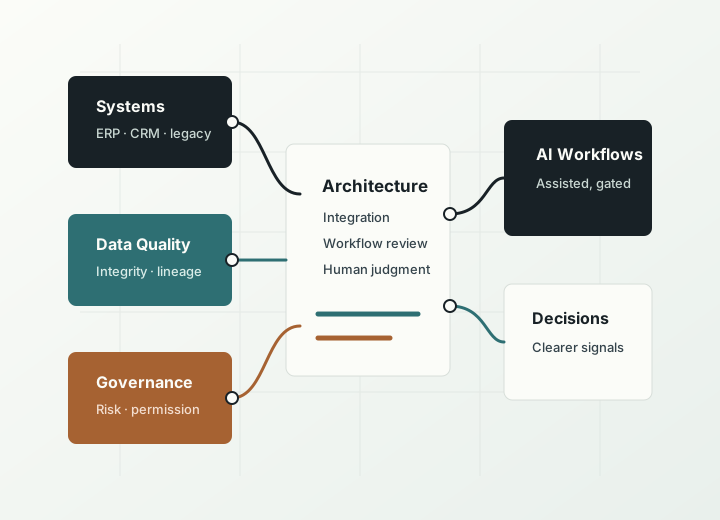
Architecture schematic showing systems of record, data integrity, governance, and AI workflows feeding decision-ready intelligence.
AI quality depends on context quality: systems of record, trusted data, clear controls, and workflows people can actually operate.
40 years in software and enterprise systems
Senior Enterprise Architect at Cadre5 since 2000
Data-heavy systems SQL Server, Oracle, C#/.NET, modernization, and integrity
Enterprise-scale work G2 Program architecture and 2010 PMI Distinguished Project Award

Why AI efforts stall

The model is rarely the first weak point.

AI efforts usually struggle upstream: vague use cases, fragmented data, unclear system boundaries, weak ownership, or governance added after the prototype already escaped the lab.

The practical work starts before implementation: clarify the business fit, prove the data path, define the controls, and sequence the first pilot so it can be judged safely.

Frameworks

Start with the foundation before buying the automation.

The readiness check below is a practical starting point. It is small enough to judge on its own and produces questions you keep either way.

Start here

AI/Data Foundation Readiness Check

A bounded review pattern for organizations under pressure to use AI but unsure whether their workflows, data, systems, and governance are ready for it.

What I examine

  • Business fit and candidate AI use cases
  • Data quality, ownership, and the paths data actually travels
  • System boundaries, integrations, and architecture constraints
  • Governance, review, and evidence requirements

What you get

  • Readiness findings in plain language, tied to your systems
  • A data-gap map showing what blocks trustworthy automation
  • Governance needs identified before they become incidents
  • A sequenced pilot plan you can judge safely

What happens next

Findings can inform the path below: discovery, a small proof, or a production-readiness discussion. There is no obligation to continue; the check stands on its own.

Talk through the assessment Try the readiness check

Task crossover mapping

AI changes who can draft the work. Governance decides what is safe to use.

As AI gets better, first-draft work starts crossing old role boundaries. A project lead can draft test cases. A technical expert can shape client-ready notes. A non-specialist can summarize material that used to wait for one overloaded person.

That can expand capacity, but only if the workflow names the reviewer, evidence, authority, and stop points. Otherwise the shadow process quietly becomes the real process before anyone has designed the guardrails.

Good AI adoption should make the team stronger, not more dependent on outside experts. The work is to simplify what should become routine, define the guardrails, and leave people able to own more of the process safely.

01 Map the task

Break one workflow into the actual units of work, not job titles.

02 Find the crossover

Identify where AI can help someone produce a useful first draft.

03 Set the guardrail

Define who reviews it, what evidence is kept, and what decisions remain off-limits.

01

Task Crossover Mapping

Identify where AI can safely expand who drafts which tasks, then define the review, evidence, and authority rules that help the team own the process instead of outsourcing the judgment.

02

Critical System Modernization Roadmap

Modernization should reduce risk, not create a new unstable platform. I assess legacy platforms, data flows, integrations, and transition paths to keep it that way.

03

Data Trust and Decision Architecture Review

When leaders stop trusting the dashboard, decisions slow down. This review covers data models, reporting paths, KPIs, semantic layers, and decision flows.

04

AI Governance and Operating Model Design

Define decision rights, review gates, evidence capture, auditability, ownership, and escalation paths that make AI usable in real operations.

05

AI Production-Readiness Review

A prototype that impressed in a demo can become a production liability. I apply enterprise-architecture discipline, security, identity, tool access, logging, evaluation, and rollback, before that happens.

06

Senior Architecture Advisory

Senior architecture judgment, technical decision support, team guidance, and delivery review when the next decision needs experienced outside perspective.

How the work starts

A bounded first step with clear decision points.

The strongest first step is a bounded discovery-and-prototype path, not a vague promise to transform everything at once.

01

Discovery Lens

Document the workflow, systems, data sources, risks, candidate use cases, and decision criteria.

02

Small Proof

Build a small proof with approved sample data, explicit review gates, and evidence the team can inspect.

03

Production-Readiness Path

Shape the hardening questions: security, monitoring, governance, integration, rollback, adoption, and the delivery team best suited to carry it forward.

Approach

Context architecture before agent architecture.

Before automating the work, structure the work. Identify where knowledge lives, which systems are authoritative, what data can be trusted, what requires review, and what evidence needs to be captured.

Start with the operating reality.

Understand systems of record, handoffs, constraints, and where current work breaks down.

Find the architecture bottleneck.

Separate data integrity, integration, workflow, and governance problems before prescribing tools.

Sequence the path forward.

Define a practical roadmap that reduces risk instead of creating another unstable platform.

Support adoption.

Design review gates, team practices, and delivery rhythms that transfer capability instead of creating consultant dependency.

Point of view

AI should fit the workflow, not the other way around.

Agents fail when context is messy. Before building more automation, make the information architecture legible enough for people and systems to trust.

Field-proven

I run the kind of environment I advise on.

This is not advice from the sidelines. I operate a governed AI environment every day, and the recommendations on this page come from what running it has taught me.

Governance that actually runs.

My agents work under enforced review gates. Every piece of agent work carries a task ID and a cost record, and each architecture decision is captured in a running decision log. Scheduled runs execute unattended and leave evidence.

Thirty agents taught me to keep six.

I started by building a full roster of more than thirty specialized agents. Operating them showed that most added bloat, not value, so I consolidated to a working core of six. Lessons like that only come from running the system.

This site is the demo.

This site and its companion, training.luttrell.works, were planned, built, and QA'd by that agent team, working under my direction and review gates.

Practiced where mistakes are expensive.

The same practices carry into my daily enterprise delivery work, including planning, code review, release management, and proposal research, on systems where errors have real consequences.

About

Enterprise architecture, grounded in delivery.

Chris Luttrell

I'm Chris Luttrell, a Senior Enterprise Architect at Cadre5 with 40 years in software development and deep experience in enterprise architecture, database transformation, Agile adoption, team building, and modernization of mission-critical systems.

Luttrell Intelligence Works is my professional home base for writing, research, practical frameworks, and lessons from hands-on AI work. The delivery side of my career lives at Cadre5, the Knoxville firm where I've spent 25+ years building mission-critical systems for national-security and commercial clients. When a project needs a team that ships, that's where I point people.

At Cadre5, I led architecture work on G2, a program management system created for the National Nuclear Security Administration to bring project, schedule, financial, and performance data into a more transparent enterprise view. The project received the 2010 PMI Distinguished Project Award.

My background includes a BS/BA and an MBA in Information Resource Management, along with long-running practical work across database architecture, data integrity, C#/.NET systems, and complex data-heavy organizations.

Contact

Talk through an AI, data, or modernization challenge.

If you are evaluating AI, modernizing a critical platform, or trying to make better use of the data already inside your organization, start with a focused conversation.

Reach Chris through LIW

Send a brief note about the challenge, the systems involved, and what decision or outcome you are trying to reach. A focused first conversation is usually enough to identify whether the next useful step is a readiness conversation, a roadmap discussion, or a Cadre5 delivery conversation when implementation is involved.

[email protected]

If the button does not open your mail app, the address is [email protected]